



AI investment is accelerating. Yet an AI strategy is not a competitive advantage. For boards and investment committees, the real question is whether AI creates enterprise value-or erodes the value of what they already own.
Organizations are investing heavily in artificial intelligence. Many have established dedicated AI strategies, appointed AI leaders and committed substantial budgets. None of this assures competitive advantage or financial return.
Michael Porter distinguishes operational effectiveness from competitive strategy. Performing existing activities better can improve performance, but sustainable competitive advantage depends on deliberate choices about how an organization competes, which activities it performs differently and which trade-offs it accepts.
Three decades later, this distinction is particularly relevant to AI.
If competitors can access similar AI technologies, adopting those technologies alone cannot guarantee lasting differentiation.
For boards and investment committees, the implications run deeper than the distinction between adoption and advantage.
Investment committees must evaluate AI in two directions: as a source of future enterprise value, and as a threat to the assumptions underpinning existing investments.
These two responsibilities-not the availability of new technology-should set AI investment priorities.
The AI Productivity Paradox: Better Performance, Limited Financial Returns
AI can reduce operating costs, improve decision-making, accelerate product development and create new products and services.
Yet the research points to a persistent gap between productivity gains and measurable financial returns.
McKinsey’s State of AI in 2026 found that 80% of respondents reported improvements in individual productivity from AI, but only 37% attributed any enterprise-level EBIT impact to AI. Just 6% met McKinsey’s definition of AI high performers.
BCG’s The Widening AI Value Gap reached a similarly striking conclusion in 2025: only 5% of companies qualified as “future-built,” achieving substantial AI value at scale, whereas 60% reported minimal revenue and cost gains despite significant investment.
These findings reveal a value-capture problem. They do not prove that dedicated AI strategies cause it.
Consider a simple example.
A company implements generative AI in customer service, reducing average handling time by 25%. Management declares the project successful.
Yet staffing costs remain unchanged, revenue does not increase and competitors introduce comparable technologies.
The productivity gain is real. The financial contribution is not-and no distinctive advantage has been demonstrated.
Which management decisions convert operational gains into financial returns-and what stops competitors from capturing the same benefits?
These are strategic and financial questions, not technological ones.
An efficiency investment can create real enterprise value without lasting differentiation-provided that value is demonstrable and actually captured.
Three AI Investment Purposes-and Why They Must Be Distinguished
Disciplined AI investment distinguishes three fundamentally different objectives.
1) Efficiency investments: Improving earnings and cash flow
These investments seek lower costs, faster processes, greater capacity or better operational quality.
Their justification should rest on measurable financial benefits, realistic implementation costs and a credible mechanism for capturing value.
Time saved is not money saved.
Financial benefits typically require process redesign, capacity adjustments or changes to operating structures.
Investment committees must establish who is accountable for converting technological gains into financial performance.
2) Strategic investments: Strengthening competitive advantage
These initiatives use AI to create distinctive products, services, customer experiences or business models.
Their contribution extends beyond cost savings to pricing power, customer retention or new revenue.
Yet access to advanced AI rarely constitutes a lasting advantage by itself.
The investment committee should ask whether the proposed differentiation rests on capabilities, proprietary resources, customer relationships or operating choices that competitors cannot easily replicate.
Strategic value lies in how AI changes competitive position.
3) Defensive investments: Protecting existing enterprise value
This third category deserves far more attention.
AI can undermine established businesses by changing customer expectations, lowering barriers to entry, enabling lower-cost competitors or rendering existing services less valuable.
An organization may have few attractive AI initiatives of its own-and still face significant AI-related threats.
For investment committees, this creates a second responsibility beyond evaluating new projects:
How could AI invalidate the assumptions behind what we already own?
For private equity firms, defensive due diligence should test three vulnerabilities:
Information asymmetry: Which revenue or margin assumptions depend on customers lacking information or expertise that AI could democratize?
Switching costs: Which retention assumptions depend on integration complexity, workflow entrenchment or process inertia that AI-enabled competitors could erode?
Margin compression: If AI lowers barriers to entry, what range of revenue or EBITDA margin erosion is plausible over the hold?
These vulnerabilities affect expected cash flows, competitive positioning and enterprise value.
If AI changes a target’s expected earnings or competitive position over the hold, is that change reflected in the acquisition price, the forecasts and the exit assumptions?
The cost of inaction deserves the same scrutiny as the cost of investment.
So, Does an Organization Need a Dedicated AI Strategy?
The answer depends on what decisions AI forces the organization to make.
A dedicated AI strategy is justified when AI demands coordinated decisions that business units cannot make on their own.
That may include enterprise-wide data capabilities, shared technology investments, common risk controls, workforce requirements or material changes to competitive position. Dedicated leadership, budgets and governance can therefore be entirely appropriate.
A dedicated AI strategy becomes problematic when its priorities and success measures are set independently of corporate strategy.
The number of models deployed, employees trained or use cases launched becomes a measure of progress-without evidence of business value. In extreme cases, investing in AI becomes the objective.
Porter’s argument about trade-offs applies directly.
A credible AI strategy should specify where the organization intends to invest, which capabilities it will build internally, where it will rely on external providers and, critically, which AI opportunities it has chosen not to pursue.
Its investment decisions must answer to corporate objectives, financial results and enterprise-wide capital allocation.
When AI fundamentally changes competitive position, the corporate strategy itself may need reconsideration. That decision belongs to corporate leadership-with board oversight.
The Risks Extend Beyond Financial Underperformance
AI introduces or amplifies AI risk that investment committees cannot treat as implementation details.
Confidential information exposure, cyber risk, unreliable outputs, IP disputes, regulatory obligations and dependence on external providers can directly affect enterprise value.
AI agents that execute transactions or interact with business systems raise further concerns: authorization, human oversight and operational resilience.
Critical AI services may also create concentration risk when models or infrastructure depend on a handful of providers.
These exposures require clear accountability and proportionate controls across the technology lifecycle, consistent with NIST’s AI risk management guidance.
In Europe, organizations must also consider the EU AI Act, alongside existing data protection and sector-specific obligations.
AI risk management belongs in the investment decision-not the implementation plan.
There is also disclosure risk.
In January 2025, the US Securities and Exchange Commission announced settled charges against Presto Automation concerning misleading statements about its AI product.
According to the SEC, the company failed to disclose third-party ownership and operation of technology in its deployed product and made misleading claims about eliminating human involvement in order-taking.
The case illustrates two due diligence concerns: the authenticity of proprietary technology claims, and the actual extent of human involvement in AI-enabled processes.
For investment committees, claims about AI capabilities, external dependencies, automation levels and expected financial benefits must be independently substantiated.
The Investment Committee’s Test: Five Questions Before Allocating Capital
Investment committees should apply the same financial discipline to AI that they apply to acquisitions, major capital expenditure and business expansion.
Five questions should guide the decision.
1. Strategic relevance: Which corporate objective does the investment serve? Does it improve operating economics, create differentiation or protect enterprise value?
2. Economic justification: What measurable improvement in earnings, cash flow or growth is expected? Are full lifecycle costs included-and who is accountable for capturing the benefits?
3. Alternatives and opportunity cost: Could conventional automation, process redesign or another investment deliver comparable outcomes at lower cost or risk?
4. Risk, dependency and resilience: What cyber risk, regulatory, operational and third-party exposures arise? Can critical services be replaced-or maintained-if a provider fails or changes terms?
5. Evidence and discipline: Which assumptions have been validated? What milestones justify additional funding-and which results would trigger termination?
These questions should support three decisions:
Approve or scale: Strategic relevance is demonstrated, the economics are credible, and material risks are understood and managed.
Stage and validate: The opportunity is promising, but critical assumptions require testing before capital is committed.
Reject or stop: Strategic relevance is missing, alternatives offer superior returns, risks are unacceptable, or agreed milestones have not been met.
Foundational investments in data quality, cybersecurity and technology infrastructure may create enterprise-wide benefits rather than returns attributable to a single business unit. They still require a credible business case and clear accountability.
Translating AI Investment into Enterprise Valuation
Investment committees allocate capital on expected returns, not strategic narratives. The link between AI investment and enterprise value must therefore be explicit.
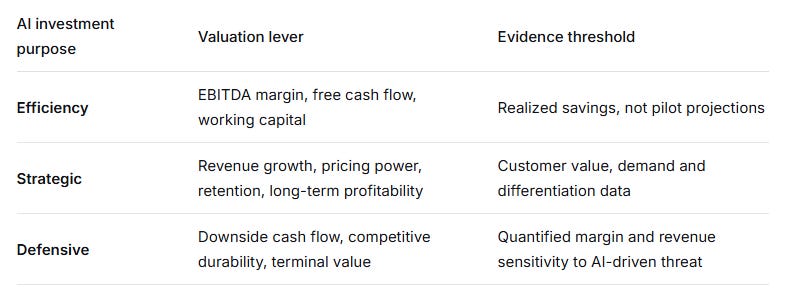
These relationships are not mechanical.
A successful efficiency investment can increase enterprise value through higher cash flows without changing the exit multiple.
A defensive investment may protect forecast earnings without affecting the discount rate.
Valuation adjustments should reflect credible changes in expected cash flows, business risk or market pricing-not assumed AI premiums or discounts.
Private Equity: AI Must Become Part of the Investment Thesis
The implications are sharpest for private equity.
BCG’s January 2026 research found that 73% of PE investors conduct digital diligence on most deals, and 29% integrate digital value creation planning into the pre-deal phase.
Yet only 22% say a target’s digital readiness influences go/no-go decisions.
These findings concern digital readiness, not AI strategy specifically. They nonetheless raise a question about how much weight technology assessments carry in investment decisions.
Bain’s Global M&A Report 2026 goes further. More than three quarters of strategic acquirers assessed AI’s impact on targets, and roughly one in five dealmakers walked away from a transaction over AI’s anticipated effect on the business.
PwC likewise recommends assessing AI’s impact on targets over a three-to-five-year horizon, including consequences for operating requirements, viability and valuation.
For PE investment committees, these findings have direct implications across the investment lifecycle:
Acquisition: Test whether AI strengthens or threatens the thesis-and reflect the finding in price and terms.
Ownership: Prioritize initiatives that improve cash flow, strengthen differentiation or protect competitive position.
Exit: Substantiate AI-related performance claims and demonstrate that the benefits are sustainable.
An attractive AI opportunity may strengthen enterprise value.
An unrecognized threat may destroy it.
The greater risk may be acquiring a business whose economics are being changed by AI-and not reflecting that change in the thesis or the price.**
The Key Takeaway for Investment Committees
An investment committee’s responsibility is to allocate capital where it creates the greatest risk-adjusted value.
AI deserves the same discipline.
A dedicated AI strategy may be necessary to coordinate investments, capabilities and risks. Its existence is no evidence of strategic success.
Investment committees must ask two questions:
Where can AI create value that justifies the capital committed?
And where could AI destroy value if the organization fails to respond?
The answers should shape investment priorities, business models, forecasts and acquisition decisions.
The true measure of an AI strategy is the quality of the decisions it enables.
Fund measurable value.
Protect enterprise value.
Never confuse adoption with progress.