



AI is compressing the time available to detect, contain and recover from cyberattacks. For investors, this raises a fundamental question: how much of a company’s valuation depends on business operations it may be unable to restore quickly enough?
In future, the year 2026 will stand out as the year where AI-assisted cyberattacks accelerated operational disruption, exposed valuable intellectual property, created unexpected financial liabilities and undermined confidence in corporate management.
In transaction terms, these risks can change the economics of an acquisition, challenge purchase-price assumptions and complicate post-acquisition value creation.
As outlined, recent incidents in 2026 provide compelling evidence that the threat is becoming more immediate.
The ability of an organization to withstand a cyberattack, maintain essential operations and recover within acceptable time limits deserves closer attention as an indicator of financial resilience.
For investors, it also raises an essential question:
Are a target company’s projected earnings as reliable as its valuation assumes?
The warning signs: What recent AI-powered cyberattacks reveal
Three developments in 2026 illustrate why cyber resilience is becoming increasingly relevant to investment decisions.
September 2026: AI-assisted espionage threatens intellectual property
In its September 2026 Threat Intelligence Report, Anthropic documented cyber operations in which threat actors used AI to automate reconnaissance, phishing, malware modification and data theft.
One operation, assessed as consistent with Russian state-linked espionage, targeted government institutions, defense organizations and technology supply chains.
Anthropic reported that the attackers stole proprietary software from a military drone technology supplier and obtained sensitive information about product architecture, supplier dependencies and an unannounced product.
The investment implications extend beyond the initial security incident.
For businesses whose valuation depends on proprietary technology, intellectual property theft can weaken competitive advantages and undermine future revenue expectations.
Deal implication: Investors should examine whether a target’s intellectual property is adequately protected, whether sensitive information has previously been compromised and how such exposure could affect its commercial position.
November 2026: AI infrastructure creates direct financial exposure
On 3 November, Google’s Mandiant and Google Threat Intelligence Group published findings concerning multiple incidents involving the misuse of enterprise access to large language models.
The attacks, known as LLMJacking, involved criminals exploiting compromised cloud credentials and AI services to consume expensive computing resources.
Mandiant documented fraudulent cloud charges exceeding $100,000 in a single day, with cumulative charges reaching $1 million at some affected organizations before access was revoked.
These figures represent fraudulent usage charges, rather than confirmed final financial losses after billing adjustments or possible recovery.
The incidents demonstrate how inadequate controls over AI infrastructure can create direct financial exposure.
Deal implication: Corporate AI adoption creates additional areas for due diligence. Investors should examine credential protection, cloud access, usage monitoring and the controls intended to prevent unauthorized consumption of computing resources.
November 2026: AI-assisted attacks move toward machine speed
On 16 November, the Google Threat Intelligence Group published findings describing how attackers increasingly use AI agents to automate multiple stages of cyber intrusions.
The research documented automated vulnerability analysis, exploitation activities and the misuse of AI coding assistants to introduce malicious software.
The UK’s National Cyber Security Centre reinforced this assessment in its November 2026 annual review.
The NCSC concluded that AI is highly likely to increase the speed, scale and efficiency of existing attack methods, placing additional pressure on organizations with legacy technologies and weaker security capabilities.
AI-enabled attacks are not universally autonomous. Human operators remain essential to many observed operations, and the capabilities of attackers differ significantly.
Nevertheless, the evidence indicates that organizations may have less time to address vulnerabilities before attackers exploit them.
Deal implication: Investors need to establish whether a target can detect, contain and recover from attacks quickly enough to protect critical business operations. Remediation plans without supporting evidence deserve particular scrutiny.
Why cyber resilience matters to investment performance
Cyber incidents can influence several assumptions underlying corporate valuations.
1. Earnings and cash-flow reliability
A successful cyberattack can interrupt production, disrupt logistics, prevent customer transactions or make essential digital services unavailable.
The resulting financial consequences can include lost revenue, reduced productivity, emergency recovery expenditure, contractual penalties and customer compensation.
For investors, the duration of an interruption becomes a direct financial variable.
A company unable to restore essential operations for several days may face materially different financial consequences from one that can recover within hours.
This makes independently tested recovery capabilities relevant to quality-of-earnings assessments and financial forecasts.
2. Protection of competitive advantage
Many businesses derive substantial value from intellectual property, proprietary software, research, customer information and commercially sensitive data.
The theft of these assets can affect long-term competitiveness even after normal operations have resumed.
For M&A professionals, the implications include increased scrutiny of intellectual property protection, incident history, commercial dependencies and contractual representations.
3. Third-party dependencies and portfolio concentration
Organizations increasingly depend on cloud platforms, software providers, managed services and AI infrastructure.
A disruption affecting a critical supplier can simultaneously affect multiple companies.
For private equity investors, this creates an additional concern: several portfolio companies may share the same technology dependencies.
A significant incident at a common service provider could therefore create correlated losses across a portfolio.
Investors should assess these exposures at company and portfolio levels.
4. Regulatory and contractual exposure
Cyber incidents can also create legal obligations and regulatory consequences.
In the United States, SEC rules generally require covered domestic public companies to disclose material cybersecurity incidents within four business days after determining materiality, subject to specified exceptions.
In the European Union, the Digital Operational Resilience Act (DORA), applicable since 17 January 2025, establishes requirements for covered financial entities concerning technology risk management, incident reporting, resilience testing and third-party ICT dependencies.
For regulated acquisition targets, identified compliance weaknesses may require remediation plans, specific contractual protections or, where commercially and legally appropriate, conditions before closing.
These requirements reinforce the importance of considering cyber resilience during legal and regulatory due diligence.
The financial impact: An illustrative investment scenario
Consider a manufacturing company being evaluated for acquisition.
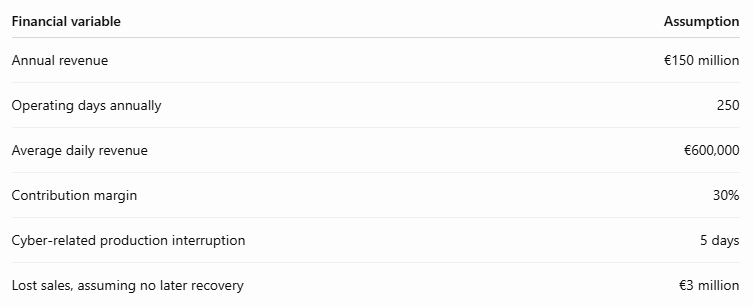
Based on these assumptions, the interruption could generate the following financial consequences:

The estimated impact excludes possible insurance recoveries, tax effects, additional customer losses and other secondary consequences.
It also assumes that the interrupted sales cannot subsequently be recovered.
For the investment committee, the immediate financial loss is only part of the assessment.
A prolonged disruption may also raise questions about customer retention, supply commitments, operational reliability and the credibility of management’s financial forecasts.
A one-off incident cost should generally be distinguished from a recurring reduction in earnings. Applying an earnings multiple mechanically to exceptional recovery expenditure would risk overstating the valuation effect.
However, if a cyber incident permanently damages customer relationships or reduces future earnings, the consequences may extend into the valuation of the business itself.
The investment implication: Cyber resilience can influence the reliability of forecast cash flows, the cost of remediation and the uncertainty investors must consider when determining an appropriate purchase price.
Cyber resilience as an indicator of management quality
Investors routinely examine management effectiveness, capital allocation, operational performance and financial discipline.
Cyber resilience deserves comparable attention because it provides evidence of management’s ability to protect business operations under adverse conditions.
Even companies with effective cybersecurity controls can experience serious incidents.
The financial consequences depend heavily on their ability to contain the attack, continue essential services and restore operations.
A management team should therefore be able to demonstrate:
Independently tested recovery capabilities for critical business services.
Defined recovery objectives and evidence that these objectives can be met.
Documented remediation of critical vulnerabilities.
Effective oversight of major technology and supplier dependencies.
Meaningful board reporting on operational resilience and unresolved exposures.
Evidence matters more than cybersecurity expenditure alone.
A company may invest heavily in security technologies yet remain unable to restore production, customer services or financial operations following a major incident.
The availability of external incident-response services adds another consideration.
In November 2026, Marsh warned that growing incident volumes were placing increasing pressure on specialist response providers.
Access to a cyber insurer’s incident-response panel does not necessarily guarantee immediate assistance.
For investors, this reinforces the importance of examining recovery arrangements, specialist response contracts and the organization’s ability to operate during a prolonged disruption.
Five questions every investment committee should ask
Cyber resilience should become a measurable part of acquisition due diligence.
The following questions connect cybersecurity findings to investment decisions.
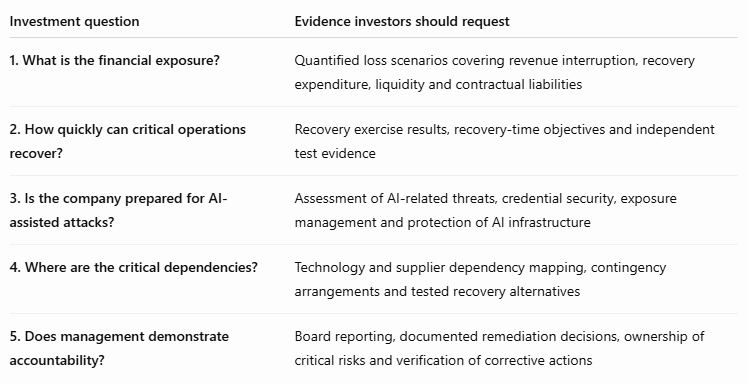
These questions should be addressed during acquisition screening and technical due diligence, then revisited throughout the holding period.
For private equity firms, the findings can also inform the first 100 days following acquisition, particularly when critical weaknesses require investment or changes in operational procedures.
From due diligence to transaction terms
Identifying cyber resilience weaknesses is only useful when the findings influence investment decisions.
Material weaknesses may justify changes to purchase-price assumptions, additional contractual protection or specific remediation commitments.
Depending on the circumstances, investors may consider cyber-specific representations and warranties, disclosures of known incidents, targeted indemnities, escrow or holdback arrangements, and documented post-closing obligations.
For example, a target with untested recovery capabilities and unsupported critical systems may require a significant remediation programme.
Where the associated expenditure can be quantified, it may affect investment assumptions or transaction negotiations.
Insurance deserves particular attention. Representations and warranties insurance may contain exclusions or limitations relating to cybersecurity matters, making review of actual policy terms essential.
Contractual protections cannot substitute for understanding the operational risk itself.
A buyer acquiring a company with substantial recovery weaknesses will still need to address those weaknesses after closing.
The objective is to identify material exposure before acquisition, determine its likely financial consequences and ensure that the transaction reflects the risks being assumed.
What cyber resilience means for company valuation
Investors generally value companies using expectations about future earnings, cash flows, growth and financial uncertainty.
Cyber resilience can influence these assumptions through several channels.
First, expected operating cash flows may need adjustment when credible evidence indicates a material probability of business interruption or permanent customer losses.
Second, identifiable remediation expenditure should be reflected in the investment plan and financial projections.
Third, uncertainty concerning future performance may affect the required return or risk assumptions used in valuation.
These effects require careful financial treatment.
Where cyber-related expected losses have already been incorporated into projected cash flows, adjusting the discount rate for the same exposure without further justification could result in double counting.
Likewise, an isolated recovery expense should not automatically be treated as a recurring earnings reduction.
The financial assessment should distinguish between temporary interruption, permanent earnings impairment, required investment and uncertainty about future performance.
There is currently no basis for assuming that cyber resilience automatically commands a universal valuation premium.
However, companies able to demonstrate credible recovery capabilities, effective governance and controlled operational dependencies may provide investors with greater confidence in their financial forecasts.
For private equity firms, this creates an additional value-creation opportunity during the holding period.
Improving recovery capabilities, addressing critical technology weaknesses and strengthening operational dependencies can reduce exposure to disruption and improve the quality of evidence presented to prospective buyers at exit.
The potential benefit needs to be assessed against the required investment, the company’s risk exposure and its commercial circumstances.
Cyber resilience should become part of investment discipline
The incidents documented throughout 2026 demonstrate that cybercriminals and state-linked attackers are already using AI to accelerate established attack methods and automate parts of their operations.
As these capabilities improve, organizations with insufficient protection, outdated technologies and weak recovery arrangements may face increasing operational pressure.
For investors, the consequences reach directly into business performance.
A target company may report attractive margins, consistent earnings and ambitious growth projections. Yet those assumptions deserve scrutiny when management cannot demonstrate how critical business operations would survive and recover from a serious cyber incident.
Financial diligence examines the reliability of reported earnings. Commercial diligence tests the sustainability of future revenue. Operational diligence assesses whether the business can deliver its plans.
Cyber resilience should become an integral part of these assessments because a company’s ability to generate future cash flows depends, in part, on its ability to maintain and restore critical operations.
For buyers, this means understanding material weaknesses before signing and reflecting them appropriately in investment decisions.
For sellers, demonstrating independently testewhere td resilience can help address buyer concerns and reduce uncertainty during negotiations.
For private equity investors, improving resilience throughout the holding period can contribute to protecting enterprise value and supporting a more credible exit.
In an era of AI-powered cyberattacks, the ability to withstand disruption and restore business operations is becoming essential to protecting long-term shareholder value.
Investors should demand evidence of that ability before the next major incident tests it.
References
Anthropic: Detecting and Countering Misuse of AI: September 2026.
Google Threat Intelligence Group and Mandiant: The Rise of LLMJacking: How Threat Actors Monetize Compromised Cloud and Model Resources, 3 November 2026.
Google Threat Intelligence Group: Agentic Threat Activity Crosses a Significant Threshold, 16 November 2026.
UK National Cyber Security Centre: The Impact of AI on Cyber Threat, 3 November 2026.
Marsh: Incident Response Capacity Is Tightening, 12 November 2026.
U.S. Securities and Exchange Commission: Cybersecurity Risk Management, Strategy, Governance, and Incident Disclosure.
European Securities and Markets Authority: Digital Operational Resilience Act (DORA).